Home · Guides · Alliances & Seats of Power
Alliances & Seats of Power
Quick answers
- How many players can join an alliance in Iron Realms?
- An alliance opens at fifty lords and its hall grows with the banner's collective might: six tiers raise the cap from 50 to 75, 95, 115, 135 and finally 156 members at the top. Alliance tags are 2 to 6 letters and must be unique within your kingdom.
- What do alliances do in Iron Realms?
- Alliances hold forts and Seats of Power, declare phased wars, run weekly bounty boards, reinforce each other's walls, and share alliance technology funded by member donations.
- What is a Seat of Power in Iron Realms?
- A Seat of Power is a named holdfast on the world map that a lord captures and holds. There are 191 of them. A seat grants a realm-wide bonus, pays hourly tribute that doubles over the first day you hold it, and counts toward the Iron Throne. Nothing takes it from you quietly: a seat changes hands only when an attacker clears its walls, its stationed garrison and every reinforcement, and then lands a Takeover blow.
- How do you capture a Seat of Power?
- Attacks and rallies grind a seat down, but they never flip it. To capture one you must clear its defence completely — wall durability to zero, the stationed garrison dead, every reinforcement spent — and then land an explicit Takeover or Takeover Rally blow, all inside a war window (02:00–04:00, 10:00–12:00 or 18:00–20:00 UTC). Clearing the defence opens a 10-minute breach window that belongs to the lord who cleared it and their alliance, so nobody can snipe your grind; the new holder's walls restart at 1.2× the tier's base. Both the seat's star rating (+8% defence per star) and its terrain (up to +20%) favour the defender, so a seat falls to a rally of up to eight waves rather than a single march. Bring siege troops — trap losses are permanent.
- Is Iron Realms free to play?
- Yes. Iron Realms is free to play in any browser with no download and no account required. Every building, troop tier and Seat of Power is reachable without spending money — purchases buy speed and cosmetics, never a higher ceiling.
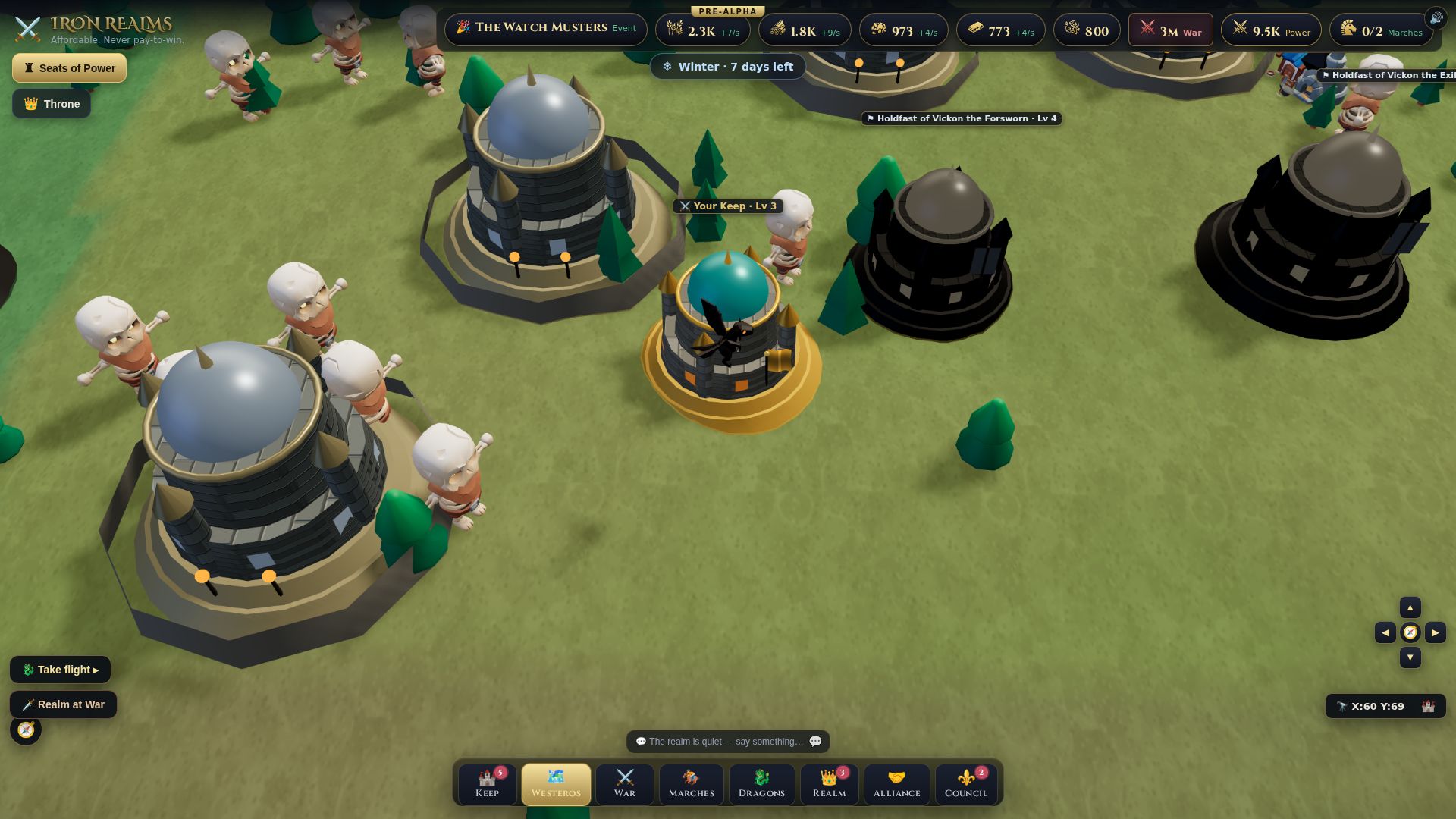
The realm is won together. An alliance — a banner of allied houses — is where the deepest game lives: shared wars, held territory, and a season-long race for dominance.
Founding or joining a banner
From the Alliance menu you can found your own banner (name, tag, sigil, and a Discord link if you like) or join an existing one. Ranks run from recruit to leader, with officer channels for the inner circle and alliance-wide chat for everyone.
Residents ride under banners too
The twenty-seven Residents hold real keeps, and they swear to banners like anyone else. If your gates stand open you will find one in your roster — riding with your rallies, reinforcing a bannermate with a march inbound, and speaking in the hall in their own voice rather than a herald’s.
They are bounded on purpose: never more than half a roster (though there is always room for one, so even a two-lord banner may gain a Resident neighbour), never a rank above Recruit, and never the Leader. A human petitioner always finds a seat, and nobody ever answers to an NPC.
Forts & garrisons
- Alliance forts are territory your banner claims on the map. Holding them grants gathering bonuses across the region.
- Garrisons — station real troops in a fort, not just gold, and recall them home when the war shifts. A well-manned fort is far harder to take.
Second a commander
Lend one of your commanders to a bannermate for an hour. They fight at 80% of their strength in another lord’s saddle — good, but not quite as good as at home — and the loan is real: while they are away you cannot field them, exactly as if they were off on a Maester Expedition.
- There is no recall. The hour brings them back and nothing else does. A loan you could cancel the moment a battle turned would be a feint rather than a gift, and your ally could never plan around it.
- One at a time. A lord may have one commander out on loan; a second lending waits until the first rides home.
- Your reckoning, the realm’s ceiling. Your own game reports the commander’s strength, because only it knows their level and stars — and the realm believes it only as far as it believes any attacker’s own figures. Inflating it means inflating a commander you are giving away.
- Not to a Resident, and not to yourself. The realm’s own characters field their own commanders, and lending to yourself is just fielding them.
It is the sharpest thing a veteran banner can do for a green one: a hard assault borrows an edge it has not earned yet, and the lord who lent it goes without.
Help the hall
The Hall tab carries one button whose entire effect lands on somebody else. Send your household through the hall and 60 seconds come off every bannermate’s running build at once — up to 30 of them in a single press — then they rest for four hours.
- It is not the Help button you already had. “Call on the smallfolk” in your own city speeds up your work and spends your twenty helps. This spends neither: an ally’s hands shave your clock and leave your own budget untouched.
- It lands where it is worth most. The seconds go to the build with the longest left to run, once. A minute off something about to finish is a minute wasted.
- Recruiting does not make it hit harder. One press reaches thirty allies at most, so a banner of two hundred helps no harder than a banner of thirty — it simply has more people who can press. The cooldown is per lord, which is what makes a busy hall a genuinely better place to be.
- An empty hall costs nothing. Press it with nobody to help and you are told so; the four hours are not spent.
- Residents are skipped. They ride under banners and hold seats, but they run no build queue for a minute to come off.
It will never finish anyone’s keep for them. It is what a banner feels like when somebody is in it with you.
The shield wall — where your banner holds matters
Seats are not only a score. Every Seat of Power your alliance holds in a region defends the others there: +5% to the defender for each holding beyond the first, to a ceiling of +30%. Three seats in the Reach and every one of them is harder to prise out; twenty seats scattered one to a region and not one of them raises a wall.
- It counts the seat under attack. A lone holding is worth nothing; the second seat in that region is the first that pays.
- It is the realm's arithmetic, not your client's. The wall is applied by the server in the same breath as the seat's own stars, its terrain and your banner's funded Bulwark levels.
- Your enemy can see it. The seat card names the wall, the number of holdings raising it and the region it covers — to the holder and to the attacker alike, before a host is spent. A defence nobody can plan against is an ambush, not a wall.
- It has a published ceiling. +30% and no further, so a well-clustered banner is genuinely hard to move and never impossible to move.
- A Resident's seat raises none. Seats held by the realm's own characters are settled by a different arbitration, which grants their holder no alliance defence at all.
The strategic reading: take the ground next to what you already hold. A banner that concentrates is far harder to break than one that collects.
Wars with goals
A declared war runs in phases with a running score. Wars end in spoils paid out to the winning side — and, increasingly, on terms: truces, hostages, and settlements let a war end by agreement instead of pure exhaustion.
The Conquest Season
The grand prize is the Conquest Season — a two-week race where alliances bank points for holding forts, storming rivals, and winning wars. The season leaderboard crowns the realm's dominant banner and pays cosmetic rewards and titles that reset each season, so every season is a fresh contest.
You cannot strike your own banner
Marches, rallies and raids against a keep or a Seat of Power held by your own alliance are refused before anything launches. The map says so before the tap — a bannermate's keep carries a 🤝 on its label and wears your own colours, so a sworn brother never looks like a target.
This is enforced by the realm, not by the interface: the block holds on every path a march can take, including the older fallback routes a stale client might still call.
The Founding — a realm's first fortnight
When a realm is young, a fourteen-day Founding event runs. Its first week banks points to the whole realm — the only week where wanting strangers to play well is correct — and its second week banks to your alliance, so a banner that recruited during the cooperative week compounds. Latecomers are welcomed by weighted catch-up rather than locked out.