Home · Guides · Seats of Power
Seats of Power
Quick answers
- What is a Seat of Power in Iron Realms?
- A Seat of Power is a named holdfast on the world map that a lord captures and holds. There are 191 of them. A seat grants a realm-wide bonus, pays hourly tribute that doubles over the first day you hold it, and counts toward the Iron Throne. Nothing takes it from you quietly: a seat changes hands only when an attacker clears its walls, its stationed garrison and every reinforcement, and then lands a Takeover blow.
- How do you capture a Seat of Power?
- Attacks and rallies grind a seat down, but they never flip it. To capture one you must clear its defence completely — wall durability to zero, the stationed garrison dead, every reinforcement spent — and then land an explicit Takeover or Takeover Rally blow, all inside a war window (02:00–04:00, 10:00–12:00 or 18:00–20:00 UTC). Clearing the defence opens a 10-minute breach window that belongs to the lord who cleared it and their alliance, so nobody can snipe your grind; the new holder's walls restart at 1.2× the tier's base. Both the seat's star rating (+8% defence per star) and its terrain (up to +20%) favour the defender, so a seat falls to a rally of up to eight waves rather than a single march. Bring siege troops — trap losses are permanent.
- Is Iron Realms free to play?
- Yes. Iron Realms is free to play in any browser with no download and no account required. Every building, troop tier and Seat of Power is reachable without spending money — purchases buy speed and cosmetics, never a higher ceiling.
- Does spending money make you stronger in Iron Realms?
- No. Nothing purchasable raises your power ceiling. A charter audit runs on every build and fails it if any offer would sell power. During the pre-alpha nothing is for sale at all — better than that, the store gives its goods away: everything in it is free to take, once a day per item, while the realm is being built. When payments do open, spending will compress time only: it clears timers, it never raises the summit.
- How long does it take to max a keep in Iron Realms?
- Keeps cap at level 45 and troops at tier 13 — the same summit for everyone, and it is a campaign: about seven months of steady play at half an hour a day, counting keep 45 and the nineteen plots that gate it. The Fair Play ledger inside the game reads that figure straight out of the shipped constants, so it is never a month behind the build.
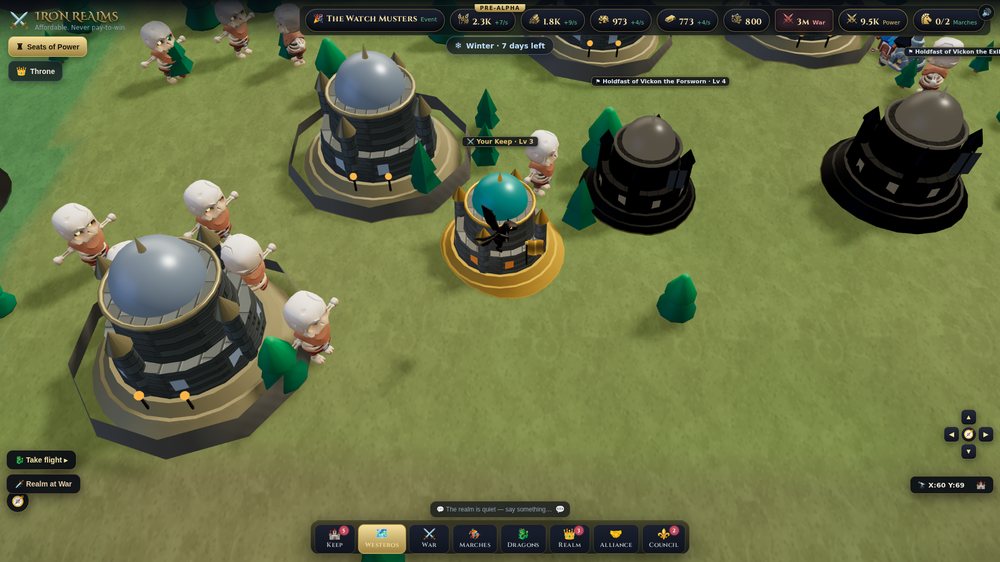
Seats of Power are the reason the world map matters. There are 191 of them across the known world — 170 in Westeros, named holds every one, from the Iron Throne at King's Landing down to the smallest holdfast, and twenty-one across the Narrow Sea in Essos, reached by ship — and each one you take pays you tribute every hour and grants a realm-wide buff. The Westerosi ones also move you closer to the throne itself; the eastern ones pay in trade, ships and craft and count for nothing in the throne race, because the Iron Throne is a Westerosi quarrel. They are also the single hardest content in the game, and they are meant to be.
The three tiers
| Tier | How many | What it is |
|---|---|---|
| The Iron Throne | 1 | King's Landing. Whoever holds it rules the realm and appoints the Small Council. |
| Great Castle | 17 | The great houses' capitals and the great cities of the east — fifteen of them four-star seats, and two (Braavos and Volantis) five. Fourteen seats in the register carry the Lord Paramount badge. |
| Holdfast | 173 | The realm's ordinary strongholds — and where every conquering banner starts. |
The register groups them by region: the Reach 25, the North 21, the Riverlands 19, Dorne 19, the Westerlands 18, the Stormlands 17, the Vale 16, the Crownlands 15, the Iron Islands 12, and the Wall 8 — and across the Narrow Sea, the Free Cities 9, the Rhoyne 8, and Sarnor and the Grass 4.
Stars: what they actually cost you
Every seat carries a rating from ★ to ★★★★★, and it is not decoration — it is the difficulty dial.
- ★★★★★ — three in the world: the Iron Throne, Braavos and Volantis. One in Westeros, two across the Narrow Sea.
- ★★★★ — a great castle, all fifteen of them, Lord Paramount or not.
- ★★★ — a holdfast that grants a large bonus, or a middling one and carries house words. 74 of them.
- ★★ — a holdfast that does one of those two things. 61.
- ★ — a small grant and no words. 38.
A seat's rating is read off what it actually hands you and whether the books gave its house a voice — not off the tier alone, and no longer off whether anyone had picked a colour for its banner. That older rule put 121 of the west's 170 seats at one star while 132 of them were held by a named House, so the rating described the palette rather than the map. Across the whole world — Westeros and the east together, now that both can be fought over — 92 seats are worth three stars or better.
Stars buy a defender two separate things, and it is worth keeping them apart, because they answer different questions.
Every swing hurts less: +8% defence per star. A four-star paramount fights you at +32% from behind its walls; the Iron Throne at +40%. On the other side, your own held stars grant an attacker's momentum of +1% per star — but hard-capped at +15%, deliberately, so that a dominant alliance can never snowball the map into a lockout.
And there is far more of it: the wall pool compounds 25% per star. This is the bigger of the two by a distance. A seat's walls are a pool you must grind to nothing before a Takeover is even possible, and each star multiplies that pool by 1.25 on top of the last:
| ★ | Wall pool | What that means |
|---|---|---|
| 1 | 1.25× | a quiet hold — a quarter more wall than its tier alone |
| 2 | 1.56× | a hold with a name or a real bonus |
| 3 | 1.95× | the best of the holdfasts — nearly double |
| 4 | 2.44× | a great castle |
| 5 | 3.05× | the three five-star seats — King's Landing, Braavos and Volantis — three times the grinding of a bare tier |
Compounding rather than adding is deliberate. The throne is not meant to read as five hedge forts stacked up; it is meant to be a different undertaking, and a flat +25% a rung would have made every rung the same size. Tenure multiplies this again — a seat held a month stands behind up to 2.5× more still — so a long-held throne is the hardest thing on the map by a wide margin, and correctly so.
Your banner adds to it too: the alliance's shared Bulwark research lends every seat it holds +1.5% of wall pool per level, +15% at a maxed tree. It is the same node that buys your troops their defence bonus, so an alliance that invested in holding ground finds that investment already counted rather than having to grind a second tree for it.
The garrisons scale far harder than the bonus does:
| ★ | Garrison | Infirmary |
|---|---|---|
| 1 | 260 infantry, 120 archers (T1) | 80 |
| 2 | 520 infantry, 260 archers, 160 cavalry | 160 |
| 3 | 850 infantry, 470 archers, 280 cavalry (T2) | 320 |
| 4 | 3,200 infantry, 1,900 archers, 1,400 cavalry, 500 siege (T3) | 1,200 |
| 5 | 6,500 infantry, 4,200 archers, 3,200 cavalry, 1,100 siege (T4) | 2,600 |
Those are the standing garrisons of unheld seats. A seat held by a living lord is defended by what that lord actually mans it with — the garrison they station, plus every reinforcement their bannermates march in — on top of a flat +10% holder's defence. Taking a seat off a living lord is a materially different job from taking an empty one, because its defence is a decision, not a table.
Durability — no seat falls in one blow
This is the mechanic that makes seat warfare a campaign rather than a click. Each seat has a wall durability pool — 100 for a holdfast, 300 for a great castle, 1,000 for the Iron Throne — and grinding it to zero is necessary but not sufficient: a seat changes hands only when the walls are down, the stationed garrison is dead, every reinforcement is spent, and a Takeover blow lands. The full chain is under Taking one below.
Worse for the attacker, the pool grows with tenure. A seat held for thirty days sits at 2.5× its base durability, and the panel says so: walls dug in +N% by tenure. Entrenched holders are genuinely entrenched.
Each won assault takes off surviving troops ÷ 20, with a floor of 50 (holdfast), 60 (great castle) or 100 (the Throne) — and siege troops add up to +50% to that damage. The floors follow the ten-blow rule, and the rule is about the bare tier: ten winning blows in a row clear a seat's base walls before stars, tenure or the banner's research are counted. Those three are exactly what turn ten blows into thirty — a fresh one-star holdfast nobody tends really does fall in about a dozen; a long-held five-star throne under a maxed Bulwark tree is a campaign. On capture the pool restarts at 1.2× the tier's base for the new holder, so the moment you win is also the moment you start being besieged.
Terrain
Stars are not the whole defensive story. Where a seat sits adds a second bonus, and the same ground slows your approach:
| Terrain | Defence | March speed |
|---|---|---|
| Mountains | +20% | ×0.60 |
| Hills | +15% | ×0.80 |
| Forest | +12% | ×0.85 |
| Marsh | +8% | ×0.70 |
| Frozen Waste | +5% | ×0.75 |
| Coast | +5% | ×1.00 |
| Desert | +5% | ×0.85 |
| Plains | 0% | ×1.10 |
A three-star hold in the mountains defends at +44% before a single reinforcement arrives. The same hold on the plains defends at +24%. Choose your war accordingly.
Taking one
Read it first — the intelligence is free
On an unheld seat, 🦅 Scout costs nothing: a high scout level returns exact garrison counts; a low one returns an estimate. On a player-held seat the raven stays home — Scout is not offered — and the seat panel's live readout takes its place, showing the walls and the stationed defence as they stand. Either way there is no excuse for opening an assault blind.
Mind the traps
Every seat is trapped — player-held ones included — Scalding Oil punishes infantry, Bolts punish archers, Spikes punish cavalry. Counts run 8/6/6 at a holdfast, 25/20/20 at a great castle and 80/60/60 at the Iron Throne. Troops lost to traps are gone — they do not go to the infirmary. Bring siege engines to clear them.
The guardian wyrm
Great castles and the Throne keep a wyrm. Your marching dragon duels it in the sky before the siege begins — duel power 180 at a great castle, 340 at the Throne. Winning folds a small attack edge into the assault; losing simply withholds that edge. It is never a penalty, so bring the dragon regardless.
Assault, rally, takeover — or stage a rally for the window
The panel's own summary is the sentence to memorise: Assault and Rally grind walls and garrison; only a Takeover blow claims the seat — and only once its defence is fully cleared.
- ⚔️ Assault — one solo blow at the walls. Available only while the war window is open. It grinds; it never changes the banner.
- 🚩 Rally — up to eight waves launched in sequence until the garrison breaks. One rally at a time, and Recall aborts it if the first waves go badly. This is how a seat's defence is actually ground down — and, like Assault, it never flips ownership on its own.
- 👑 Takeover and 👑🚩 Takeover Rally — the same storm, sworn to end with a banner change. If the blow (or the rally's last wave) finds the defence fully cleared — walls at zero, stationed garrison dead, every reinforcement spent — the seat is yours.
- ⚑ Stage rally — when the window is shut, pre-stage a rally that fires automatically the instant it opens. The single most useful button on the panel for anyone who cannot be at the keyboard at the right minute.
The breach window — your grind cannot be sniped
The moment a seat's defence is fully cleared, the panel raises the alarm: "🚨 The defence is BREACHED — the takeover window closes in ~Nm." For 10 minutes the takeover belongs to the lord who cleared it and their alliance, and nobody else — a stranger who wanders up to an open gate is refused. Break a seat and dawdle past those 10 minutes, though, and you have done a rival's grinding for free.
Seats are assailable only inside a scheduled war window: three fixed two-hour windows a day, at 02:00–04:00, 10:00–12:00 and 18:00–20:00 UTC — three so that every timezone gets at least one at a waking hour. The panel counts down to the next either way — "⚔️ War window OPEN — closes in N" or "🕊️ At peace — war window opens in N".
Intrigue — the cheaper road, on unheld seats only
Not every seat needs an army. On unheld seats you may 🕊️ Turn its lord (holdfasts only, and no war window required), ☠️ Spoil its stores for a one-time softening of about 40% — though it can never drag a seat below half its full durability — 🗡️ Send a Faceless Man to thin the garrison by roughly a quarter for a window, or 🐦 Plant spies for exact intelligence. Each costs gems, carries a success chance, and has a cooldown.
None of this works on a rival lord's seat. Every scheme on the list is withheld on player-held ground — a living holder cannot be turned, spoiled, thinned or spied out. Against another lord the only roads are the walls and the war window.
The rebellion window
On a recurring cycle the realm rises, and while the window is open the defenders of high-tier seats are cut by 35%. It is anchored to the shared season clock, identical for every player, and cannot be bought or rerolled. Holdfasts are excluded — this is the door to the seats you could not otherwise touch, and it is the single best moment in the game to swing at a great castle.
Holding one
Man it — walls alone are arithmetic
And you are not alone on it: every other seat your banner holds in the same region adds +5% to this seat's defence, to a ceiling of +30%. The seat card prints the figure, so an attacker reads it too — a cluster of allied holdings is a visible wall, not an ambush.
Your walls restart at 1.2× the tier's base the moment you take a seat — stabilized, not full — so the moment you win is also the moment you start being besieged. (Stars and your banner's research still apply to the ceiling those walls climb back toward, so a great seat rebuilds to a great pool; it just does not start there.) Three things stand between you and the next takeover: station a garrison of your own troops on the seat, have bannermates march reinforcements to it, and remember that your peace shield does not cover a seat: a Seat of Power is public, contested ground, and while your keep rests behind its bubble the seat stands outside it, defended only by what you and your bannermates put on it (raising a blade against another player still drops the shield over your walls). An attacker must grind through all of it — walls, garrison and reinforcements — before a Takeover can even be attempted.
Upkeep — what holding one actually costs
There is no gold subscription for holding a seat, and no seat is ever taken from you quietly. A seat changes hands one way: an attacker clears its walls, its stationed garrison and every reinforcement, then lands a Takeover blow. Absence alone does not cost you a seat.
This page previously described a seat "lost to neglect" after a day below a fifth of its durability. That rule was written for the offline model and no realm-side pass has ever run it, so the promise was stronger than the code — we would rather say so than leave you planning around a deadline nobody enforces. "Upkeep" means what it sounds like: keep the walls manned, because low walls are what makes the next Takeover land.
Reinforcing — repairing the walls that actually stand
On a seat you hold, the walls a rival's storm meets are the realm's, and the panel's garrison readout is that number, not a local guess. Reinforce Garrison repairs them: no war window needed, and it works inside an attacker's 10-minute breach window, where it is the holder's whole counterplay — put the walls back up before the Takeover blow arrives and the seat stays yours. Each point of durability costs:
| Tier | Troops / point | Resources / point | Regen / hour |
|---|---|---|---|
| Holdfast | 10 | 25 stone, 18 iron | 20 |
| Great Castle | 18 | 55 stone, 42 iron | 50 |
| Iron Throne | 30 | 110 stone, 85 iron | 140 |
What a seat pays you
Five layers, and they stack.
1. The seat's own buff
Every seat carries a named bonus, and they sum across everything you hold. A seat's stars multiply its own bonus — ×1 at one star, ×1.25, ×1.5, ×2 and ×2.5 at five — so the grand prizes are not just harder, they pay more for the same effect. King's Landing grants realm-wide research +50% and the right to appoint titles. Dragonstone grants dragon XP +40%. Winterfell grants troop training +24%. Holdfasts draw from a pool of attack, defence, march speed, gathering, scout range, resource cap, training and research effects — +8% at one star, +10% to +12.5% at two, +15% to +18% at three.
2. The land's own gift
Besides its own named bonus, every seat grants a second one that belongs to the region it stands in rather than to the castle. The North gives timber, the Iron Islands iron, the Vale stone, the Reach food, the Riverlands march speed along the river roads, the Westerlands storage, the Crownlands construction, the Stormlands training, Dorne scout range, the Wall slower enemy marches, the Free Cities trade, the Rhoyne research, the grass gathering. Thirteen regions, thirteen different gifts, each scaled by the seat's stars exactly as its own bonus is — +5% at one star, +12.5% at five.
A region's gift counts once, at the best seat you hold in it. Twenty-one holds in the North draw one wolfswood, not twenty-one. That makes a realm spread wide and a realm concentrated deep genuinely different strategies — and taking a better hall in a region you already hold is still an upgrade, because the gift arrives at the better seat's rating. Each seat's card names its region's gift and says plainly that it counts once.
3. Seat Dominion
Your total stars held grants +2% production and +1.5% keep defence per star, soft-capped at 60 stars. Twenty one-star holdfasts are worth exactly as much dominion as four five-star seats — which is why sweeping the cheap seats is a real strategy and not a consolation prize.
4. Reign tribute — and why you should not trade seats
A held seat pays every hour, split evenly across food, wood, stone and iron: 400 at a holdfast, 1,200 at a great castle, 4,000 at the Iron Throne, which alone also mints 20 gems an hour.
Then the multiplier: tribute climbs steadily from 1.0× to 2.0× over the first 24 hours you hold the seat, and caps there. Losing a seat and retaking it resets that climb to zero. A seat held for a day is worth twice a seat captured this morning, and that single rule does more to shape alliance behaviour than any other number in the game.
5. Throne Points
King's Landing is worth 100, Dragonstone 40, a paramount capital 35, another great castle 22, a holdfast 10 — and 100 is the target. You can reach the throne by taking King's Landing outright, or by assembling the realm around it.
Bestowing titles
Every seat you hold except the Throne lets you name one household title — and which office depends on how great the seat is, so a greater hall names a greater officer:
- 🗝️ Castellan — a one-star holdfast. +3% defence.
- ⚔️ Master-at-Arms — a two-star holdfast. +3% troop training.
- 🕊️ Keeper of the Rookery — a three-star holdfast. +3% research speed.
- 📜 Seneschal — a great castle. +4% gathering yield.
- 🏛️ Magister — a five-star great castle, which means Braavos or Volantis. +4% tribute.
Name a flavour lord and it is pure roleplay; name yourself and the bonus is yours. Stacked household bonuses are capped at +15% per stat, so self-appointing across the map cannot be turned into real power: five Castellans reach that ceiling and a sixth pays nothing, while a Master-at-Arms on that sixth seat pays in full. The Iron Throne is the exception, because it has the Small Council instead — eight offices now, including the Master of Laws, the Lord Commander of the Kingsguard and the Commander of the City Watch. See Titles, Prestige & Ascension.
Seat Monuments
Every seat you have ever held keeps a ledger of your reigns there — "🗿 Seat Monument — claimed N times", with the five most recent listed as held 3d, lost 12 March or still held, 6d and counting. It grants nothing. It is simply the world remembering, and it is worth opening on a seat you have fought over for a season.
Where to go next
- The Seats of Power database — every contestable seat, region by region, with its tier, star rating, throne points and buff.
- Creating & Managing an Alliance — seats are won by banners, not by lone lords.
- Combat Guide — the troop triangle you will need at the walls.
- Anatomy of a Seat Siege — one capture, start to finish.
- Rally Coordination — timing eight waves with fifty lords.
- The Lord Profile — where the Valyrian steel and named blades you win here end up.