Bestiary
Quick answers
- Is Iron Realms free to play?
- Yes. Iron Realms is free to play in any browser with no download and no account required. Every building, troop tier and Seat of Power is reachable without spending money — purchases buy speed and cosmetics, never a higher ceiling.
- Does spending money make you stronger in Iron Realms?
- No. Nothing purchasable raises your power ceiling. A charter audit runs on every build and fails it if any offer would sell power. During the pre-alpha nothing is for sale at all — better than that, the store gives its goods away: everything in it is free to take, once a day per item, while the realm is being built. When payments do open, spending will compress time only: it clears timers, it never raises the summit.
- How long does it take to max a keep in Iron Realms?
- Keeps cap at level 45 and troops at tier 13 — the same summit for everyone, and it is a campaign: about seven months of steady play at half an hour a day, counting keep 45 and the nineteen plots that gate it. The Fair Play ledger inside the game reads that figure straight out of the shipped constants, so it is never a month behind the build.
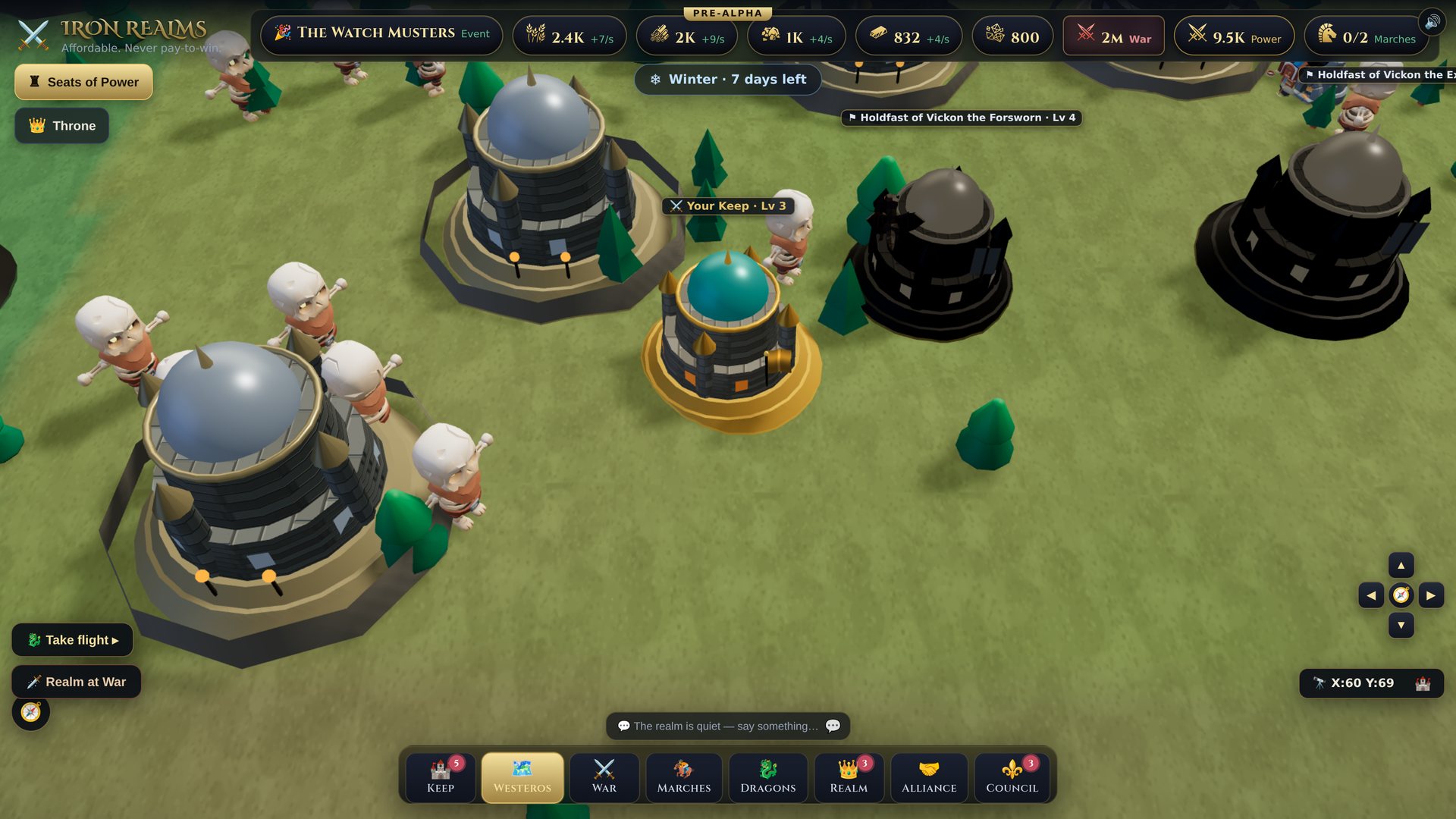
The world between the keeps is full of foes. There are 520 creature camps on the map at any moment — 400 across Westeros and 120 in Essos, plus rebel holdfasts, feral raids and a boss that wanders. Here is what stalks the wilds, what it drops, and what it costs you to take it.
Energy — the only thing that limits your hunting
Attacking a camp costs energy. You hold up to 1,000, and it regenerates at 2 per minute — so a full bar takes eight hours and twenty minutes, and a night's sleep very nearly fills one. This is the game's one soft daily cap, and both halves of it moved together: the deeper bar means a working day no longer wastes your regeneration, and the doubled rate means there is twice as much of it in a day — 2,880 rather than 1,440.
The ladder of foes
Camps are level-banded, and the wilder the country the higher the band. Each creature leans toward a troop type, which is the whole tactical content of hunting — send the counter, not your biggest stack.
| Level | Foe | Leans |
|---|---|---|
| 3 | 🧟 Wight Horde — the restless dead, shambling south | Infantry |
| 6 | 🐺 Direwolf Pack — great wolves, big as ponies | Cavalry |
| 10 | 🗿 Free Folk Giant — hurling boulders and uprooted trees | Ranged |
| 14 | 🦅 Warg Raiders — skinchangers riding the minds of beasts | Cavalry |
| 20 | ❄️ A cold shadow that flings lances of pale blue ice | Ranged |
| 30 | 💀 The first of the Others, commanding a dead host | Infantry |
Camps respawn ten minutes after they are cleared, so a well-worked stretch of country is a renewable resource rather than a race.
The eastern bestiary
One hundred and twenty of the 520 camps stand in Essos, and none of them is reachable overland. They begin at level 12 — there is no starter camp across the Narrow Sea — and a host only reaches them once a harbour stands, hulls are laid, the fleet is not still out on a raid, and the berths can carry the party. The same beasts, on harder ground, for more:
- Three times the haul. Food, wood, stone and iron all pay triple what the same level pays in Westeros.
- Double the gems. One per two levels rather than one per four.
- Half again the commander experience.
- Valyrian steel. One ingot per twelve levels of the beast — the only creature source in the game, and the reason a level-24 eastern camp is worth a voyage a level-24 western one is not.
The energy cost is unchanged, so the east is not a grind tax: it is the same bar spent on richer ground, once you have paid for the road with a harbour and a fleet.
Why the deep camps matter
Level 20 and above is where the named blades come from — twelve of them exist, none can be forged or bought, and felling the great beasts is one of only two ways they enter the world. The deep camps are also the source of the creature gear sets: the Direwolf Ward, the Giant's Warband and the Frozen Legion, each forged from a beast's signature drop and each paying a set bonus at three pieces.
Rebel holdfasts
Keep-shaped enemies with real walls and a garrison lean to counter-pick — the bridge between hunting camps and assaulting a Seat of Power. They drop resource-heavy loot and, sometimes, a blade. Scout before you storm; see the Combat Guide.
The wilds push back
This is the mechanic most lords learn the hard way. Leave a region unhunted and it escalates: one level every 24 hours, to a maximum of six. At escalation 4 the country turns feral and starts sending raids at you, on an eight-hour cycle.
So the wilds are not scenery you may ignore. An unpruned map is an actively hostile one, and the cheapest defence in the game is a lord who spends his energy rather than banking it.
The wilds do fight fair, though — fairer than they used to. A feral raid honours the same two protections as any raider: it never touches a lord still inside the new-lord grace, and it takes only from the surplus above your protected reserve (your power floor plus the Depot's vault), so a keep is never skimmed toward empty. And a peace shield stops it outright.
The migrating world boss
A great beast wanders the map — a rogue wyrm gone feral, a leviathan dragged ashore by a black storm, a raptor bigger than a sept. Rally to it for a heavy shared payout. Beyond the Wall, a separate weekly boss waits for your whole alliance: see North of the Wall.