Home · Guides · Combat & Marches
Combat & Marches
Quick answers
- How does combat work in Iron Realms?
- Marches and rallies carry troops to a target; battles resolve from a server-issued seed so results cannot be manipulated client-side. Troop types counter each other in a triangle, terrain slows attackers and aids defenders, and losses are distributed across the stacks sent.
- Is Iron Realms free to play?
- Yes. Iron Realms is free to play in any browser with no download and no account required. Every building, troop tier and Seat of Power is reachable without spending money — purchases buy speed and cosmetics, never a higher ceiling.
- Does spending money make you stronger in Iron Realms?
- No. Nothing purchasable raises your power ceiling. A charter audit runs on every build and fails it if any offer would sell power. During the pre-alpha nothing is for sale at all — better than that, the store gives its goods away: everything in it is free to take, once a day per item, while the realm is being built. When payments do open, spending will compress time only: it clears timers, it never raises the summit.
- How long does it take to max a keep in Iron Realms?
- Keeps cap at level 45 and troops at tier 13 — the same summit for everyone, and it is a campaign: about seven months of steady play at half an hour a day, counting keep 45 and the nineteen plots that gate it. The Fair Play ledger inside the game reads that figure straight out of the shipped constants, so it is never a month behind the build.
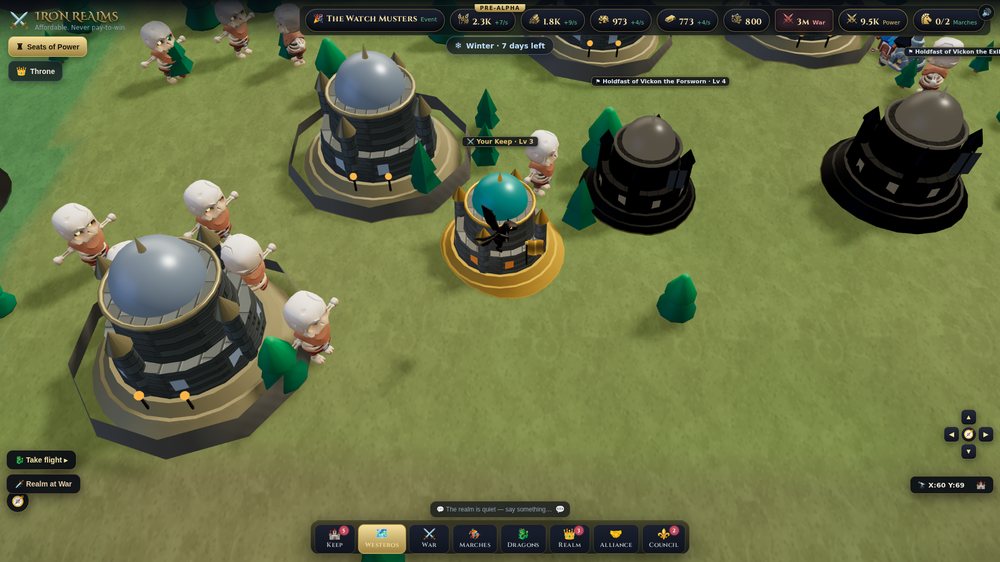
War in Iron Realms is deliberate. Armies march in real time across the map, terrain matters, and a beaten lord is never beaten for good. Here is how it all fits together.
Troops & counters
Four troop types form a rock-paper-scissors triangle, plus siege:
- Infantry — the shield wall; strong against cavalry.
- Cavalry — the hammer; strong against ranged.
- Ranged — the volley; strong against infantry.
- Siege — batters walls and garrisons; weak in the open field.
Bringing the right mix for your target — and your commander's skills — decides most battles before a blow lands.
Raids & timed marches
- Raid — a same-kingdom strike on a rival keep, resolved fairly: the outcome is decided by a server-minted secret, so nobody can rig a win. It is not, however, silent. The defender gets a banner, a horn and the arrival time, with minutes to reinforce or shield, and their ramparts fell part of your host before the walls are even reached. Pick 25%, 50% or 100% of your army when you send it.
- March — send an army across the map on a real timer: attack, scout, or reinforce. You watch it travel and can recall it from the Marches panel. Your Keep sets how many hosts you can have out at once: two, plus one more for every five Keep levels — council bonuses can add to that. Gathering parties draw from the same pool, so a field march and a forage errand compete for the same slots rather than each getting their own.
- Rally — gather allies into one great host against a tough target. Your Training Yard sets how large a rally you can lead.
Seats of Power
Seats are the crown jewels of the map. Holding one grants realm-wide buffs and Throne Points, and prestigious seats are guarded by more stars — harder to take and hold. A banner that holds several seats in one region raises a shield wall: +5% to the defender for every allied holding beyond the first, to a ceiling of +30%, and the seat card prints the number to attacker and holder alike. Sieging a seat rewards planning: encircle it, feint, time your sortie, and keep your host's morale up. The pre-battle screen shows terrain and a forecast so you march informed.
Terrain
The land fights beside the defender. Rough ground and forests slow marches, and a garrison in the right terrain gains a real defensive edge. Read the tile before you commit — the map tells you what each biome does.
Shields & the comeback rule
Losing is not a dead end. If your walls are broken and your defence is wiped entirely, a safety valve relocates you and raises a shield — applied, not offered, so it protects a lord who was asleep rather than farmed — the game is designed so a bad night reads as a comeback, not a punishment. Seasons help too: winter hands the defender an edge (see Seasons & Weather).